Ablation (RFA/PFA) for atrial fibrillation
With this patient information, we would like to welcome you to the Heart Clinic at Mølholm Private Hospital and inform you about ablation treatment for atrial fibrillation (AF).
The staff will do their utmost to ensure that you feel safe and well cared for during your stay. Our goal is to combine professional treatment with good personal care.
Experience with ablation treatment for atrial fibrillation
In patients with paroxysmal atrial fibrillation, 80-90% of patients will benefit from ablation treatment. If atrial fibrillation is continuously present (persistent AF), the success rate is lower - around 70%.
RFA (Radiofrequency Ablation) or PFA (Pulsed Field Ablation)
Whether RFA (heating of the tissue) or PFA (electrical treatment) is used, the goal is to eliminate the abnormal electrical impulses that trigger atrial fibrillation. We use primarily PFA treatment, but both treatments are comparable regarding efficacy.
General information
What to bring
Toiletries, slippers, and comfortable clothing. Also, bring your usual medication.
You are welcome to bring a companion, but it is not necessary. You may carry a small bag or cabin suitcase with change of clothes and toiletries, and you may drive or use public transportation (including flights) the day after the procedure.
Medication
You should continue your usual medication up to the day of admission. This also applies if you are taking blood thinners such as DOACs (Dabigatran/Apixaban/Rivaroxaban/Edoxaban) or Warfarin.
Your doctor may also have determined that you do not need blood-thinning medication before the ablation procedure. However, it is mandatory to take this type of medication for at least 3 months after the procedure to avoid thromboembolic complications.
Do not take diuretic medication on the morning of the admission day.
If you have diabetes, please follow this link – click here.
Shaving
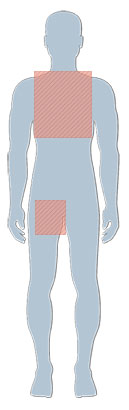
We kindly ask you to remove any hair from your chest and right groin with a disposable razor the day before admission.
You should shave the chest and groin corresponding to the shaded area:
Preparation at home (fasting rules)
You must fast from solid food for at least 6 hours before your appointment time. However, you may drink fluids up to 2 hours before (no dairy products).
You are not allowed to smoke for 2 hours before your appointment.
Visiting hours and phone contact
You are welcome to bring a companion, but it is not necessary. Your relatives can contact the secretariat during your stay at +45 76 42 74 20.
Mobile phones are allowed.
Day of admission
Preparation for treatment
On the day of admission, a nurse will receive you, help you settle in, and provide information about your stay. You will be informed of the final treatment time and any specific precautions associated with the procedure.
A plastic cannula will be inserted into a vein in your arm. Blood pressure and pulse will be measured, and an ECG will be taken. Relevant blood tests may also be performed.
The treating doctor will speak with you just before the procedure and provide details, including whether there are any specific factors related to your arrhythmia that could affect the treatment's effectiveness or potential side effects. There will be sufficient time for this discussion, and your relatives are, of course, welcome to participate.
The procedure
The treatment lasts approximately 1.5-2 hours. Various technical equipment, such as computer screens and X-ray equipment, will be used in the treatment room. Learn more about the use of X-rays here: X-rays
Before the catheter procedure itself, a special ultrasound examination of the heart from the esophagus (TEE) will be performed. This is done to rule out the formation of "blood clots" on the inside of the left atrium, despite blood-thinning medication. If clots are detected, there may be a risk of them dislodging during the procedure, which would require postponing the operation. However, this risk is extremely low.
In practice, this examination, as well as the rest of the treatment, will be performed under deep sedation or general anesthesia.
Thin catheters are inserted into the heart via blood vessels in the groin. These catheters measure the electrical activity of the heart. By heating the catheter tip to approximately 65°C or delivering repeated electrical impulses, the source of the arrhythmia is eliminated. Whether heating (RFA) or electrical impulses (PFA) are used is the operator's choice and does not affect your expected outcome.
If you have atrial fibrillation during the procedure, we will attempt to restore normal heart rhythm (sinus rhythm) by delivering an electrical shock to the chest (DC-conversion).
After the procedure
After the procedure, all plastic tubes will be removed, and you will be monitored by a nurse for the next 2 hours, during which time you must remain flat in bed to minimize the risk of bleeding from the groin insertion site.
If you experience discomfort, pain, warmth, or swelling in the groin, please inform the nurse.
Discharge
Your expected discharge time will be stated in your appointment letter.
Before discharge, the insertion site will be checked, and you will have a consultation with the treating doctor. There will be an opportunity to discuss any future precautions.
You will receive discharge papers, and we will also send a discharge letter and a description of the treatment to your general practitioner and the hospital or cardiologist that referred you to the treatment.
You may drive or use public transportation (including flights) the day after the procedure.
Complications
In rare cases (overall risk less than 1%), complications may arise:
- Larger hematoma at the insertion site, and rarely arterial pseudoaneurysm
- Accumulation of blood around the heart (pericardial effusion)
- Impact on pulmonary veins
- Temporary paresis of the phrenic nerve
- Air bubbles (coronary or brain arteries)
- Coronary spasms
- Formation of small blood clots in blood vessels, the heart, or other organs (brain, kidneys, lungs)
These complications may require observation or special treatment, which can be performed on-site.
At home again
During the first week, you should protect your groin by avoiding heavy lifting and long walks. We recommend waiting a total of two weeks before resuming sports.
You can return to your usual work approximately 1 week after discharge. If your work involves heavy physical labor, you should wait for 2 weeks.
Hot tubs, spas, and seawater should be avoided for 14 days.
Aftercare
You may notice a small bruise at the right groin insertion site. Some patients may experience a slightly larger hematoma, which may cause discomfort during the first couple of weeks after the procedure.
Many patients experience chest pain, pressure, or soreness in the first few days after the procedure. If necessary, you may take one gram of Paracetamol. However, do not exceed four doses in 24 hours (every 6 hours). It is also common to experience mild headaches. You may also experience occasional migraine episodes with aura. We sometimes observe this in the days following the ablation. We don't fully understand why it happens, but it is harmless, and the symptoms will subside on their own.
Typically, we recommend continuing with your heart rhythm-stabilizing medication for an additional 4 weeks after the procedure. Similarly, you should continue with blood-thinning medication for at least 3 months after the procedure.
Many patients may experience palpitations or atrial fibrillation after the treatment. This can be due to irritation of the heart muscle caused by the procedure and does not necessarily mean that the treatment was unsuccessful. You may experience more frequent episodes of arrhythmia during the first 2-3 months after the treatment, after which the symptoms usually subside. Therefore, the final effect of the treatment can usually only be evaluated after approximately 3 months. It may be necessary to repeat the treatment. Experience shows that about 20% of patients will need a second treatment before the optimal result is achieved.
If you experience palpitations/atrial fibrillation:
- If the symptoms are the same as before the treatment, you can wait to see if the episode resolves on its own.
- If the symptoms are different from usual, we recommend seeing your general practitioner for an ECG. If needed, the ECG can be sent to us for evaluation.
- If the episode is unbearable, contact a doctor/emergency doctor to arrange hospitalization at your local hospital for "shock" (DC-conversion).
- If you experience a relapse of atrial fibrillation but are not significantly affected by it, you may wait a couple of days to see if it resolves on its own. If atrial fibrillation does not stop within two days, contact your doctor for hospitalization at your local hospital for "shock" (DC-conversion). You are always welcome to contact us if you have any doubts.
In the case of frequent relapses after the procedure, more efficient heart medication may be needed to stabilize the heart rhythm. We often recommend Amiodarone for a 3-month period. Most patients tolerate this well without significant side effects.
In case of severe chest pain, difficulty of breathing, or fainting, you should seek medical attention.
Want to know more...
We invite you to find more information on our blog about arrhythmias: rytmedoktor.dk/en/
If you are in doubt or have any questions, feel free to contact the Heart Clinic Mølholm by phone at +45 76427420 or email: hjerte@molholm.dk
Specialists and practitioners